The outside reading novel I chose this time around is "No Country for Old Men" by Cormac McCarthy. There were many reasons I chose this. First of all, someone recommended it to me as one of their favorite books. I also watched the movie, which had some interesting parts, but I wasn't really paying attention. I don't read a lot, and when I do the setting is not usually in a 1980s Texas, and that intrigued me. Also, it looks like it has a lot of action, which I enjoy.
Thursday, December 17, 2009
No Country for Old Men
The outside reading novel I chose this time around is "No Country for Old Men" by Cormac McCarthy. There were many reasons I chose this. First of all, someone recommended it to me as one of their favorite books. I also watched the movie, which had some interesting parts, but I wasn't really paying attention. I don't read a lot, and when I do the setting is not usually in a 1980s Texas, and that intrigued me. Also, it looks like it has a lot of action, which I enjoy.
Monday, November 30, 2009
Wednesday, November 11, 2009
Thursday, October 29, 2009
Outside Reading #2
I reversed the order, so that the last one was first, and the first one was last.
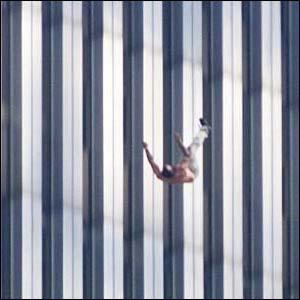
When I flipped through them, it look like the man was floating up through the sky.
And if I'd had more pictures, he would've flown through a window, back into the building, and the smoke would've poured into the hole that the plane was about to come out of.
Dad would have left his messages backward, until the machine was empty, and the plane would've flown backward away from him, all the way to Boston.
He would've taken the elevator to the street and pressed the button for the top floor.
He would've walked backward to the subway, and the subway would've gone backward through the tunnel, back to our stop.
Dad would've gone backward through the turnstile, then swiped his Metrocard backward, then walked home backward as he read the New York Times from the right to left.
He would've spit coffee into his mug, unbrushed his teeth, and put hair on his face with his razor.
He would've gotten back into bed, the alarm would've rung backward, he would've dreamt backward.
Then he would've gotten up again at the end of the night before the worst day.
He would've walked backward into my room, whistling "I am the Walrus" backward.
He would've gotten into bed with me.
We would've looked at the stars on my ceiling, which would've pulled back their light from our eyes.
I'd have said "Nothing" backward.
He'd have said "Yeah buddy?" backward.
I'd have said "Dad?" backward, which would have sounded the same as "Dad" forward.
He would have told me the story of the Sixth Borough, from the voice in the can at the end to the beginning, from "I love you" to "Once upon a time. . ."
We would have been safe""(326).
This extremely meaty passage shows a lot of the voice Jonathan Safran Foer expels through Oskar Schell. To add context to this quote, Oskar is imagining what would have happened if he was able to reverse the events of September 11th, 2001, in which his father's life was taken. The author uses a lot of parallel structure in this particular passage. Would've is used many many many times to emphasize the undoing of actions. Oskar undoes every single event of that day, no matter how small or insignificant it may seem, to completely reverse the tragedy. He does not change one part; he changes all of it. His attention to detail, shown here as the day to day activities his father does, shows how much he cares about what has happened. It also fits in with his character's personality traits; he is intelligent and knows a lot of obscure facts the average person might not care about. He includes unique characteristics of his father, such as the "I am the Walrus" song, as well as the common ones, like drinking coffee. He knows everything about this one person, and they obviously meant a whole lot to him. He truly valued the time he was able to spend with his father, one of the few people that could actually understand him. It also shows how desperate he is to complete an unachievable goal. He wants his father back, but that will never happen. Oskar represents human emotion, exaggerated as a child and even more exaggerated as an autistic child. He has a hard time dealing with his feelings as it is, and the loss of his father just adds a whole new level of hardship to overcome. Oskar deals with this by inventing and hoping for the impossible.
Thursday, October 15, 2009
Oprah Winfrey interviews Jonathan Safran Foer
Q: Why would you make a nine year old child the main narrator? Child protagonists can be very unreliable.
A:Although Oskar Schell is a child, he is very educated. He sees things that a normal nine year old, or even an adult would not. He is an atheist, pacifist, and takes French lessons. Most children that age do not explore the ideas of pacifism and atheism enough to truly become followers. Oskar is an exception and serves as the drive for the story that can effectively communicate what is happening due to his increased perception of the word around him, but also get across the human feelings one would feel of loss or desperation in it's purest form, from the eyes of a child. Oskar is the ideal protagonist, honest and able to help the reader understand everything they need to know to feel what he does.
Q: The use of images in a novel is very uncommon. For what reasons did you include them?
A: I included them in the novel to accent Oskar's thoughts. When Oskar sees something significant, interesting, or an important symbol I included a picture. Because this novel is supposed to put you in the shoes of the protagonist, I thought it helpful to see what they see. Books usually only allow you to see what they are thinking. I took this a step further and added pictures so when you read what Oskar was thinking about one of them, you could see why or where he was coming from.
Q:The viewpoint of the story changes in various points around the novel. Why is that significant/how does it relate to the current story?
A: The novel is told from the first person perspective of three people. These three are Oskar, his grandfather, and his grandmother. What Oskar experiences throughout the novel mirrors what had previously happened to his grandfather. His grandfather had someone he loved, Anna. She was killed in a firebombing of their villiage which devastates him. He marries Anna's sister, almost as a way to provide closure to the loss of his loved one. In Oskar's case, he loved his father, who died during the terrorist attacks on September 11th 2001. His mission to find out what his father's key unlocks is his form of closure, they are very similar to his grandfathers. I included this because I wanted the readers to see how an adult, or just another person, would react in the same situation.
The author's personal website can be found here.